Title: Designing adaptive breeding populations for a changing environment
Abstract
Breeding programmes have been historically shaped by genotype by environment interaction (GxE), as it reflects where genetic variation is expressed, which genotypes are selected and how they perform across the target population of environments (TPE). With an influx of increasingly accessible technologies for modelling and predicting GxE, it is important that plant breeding research continues to move forward while remaining connected to the breeding objectives and decisions being targeted.
While substantial effort has been directed towards predicting genotype performance under changes in the TPE, far less attention has been given to how generating new breeding populations through selection and crossing also changes the structure of G×E. This talk will present recent work on translating G×E modelling into actionable breeding decisions. We will show how G×E patterns in new breeding populations can be predicted across changing environments, allowing breeding objectives to be expressed in terms of future performance, stability and adaptation profiles. Looking forward, the aim is to predict which genotypes perform well under a changing climate and to actively shape breeding populations so that future candidate varieties have the yield, stability and adaptation patterns required for release to growers.
About Daniel Tolhurst
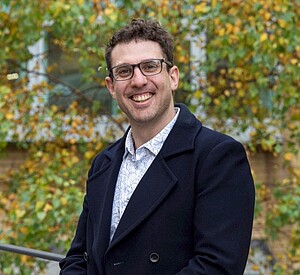
Daniel Tolhurst is an Edinburgh Innovation Fellow who leads the Biometrics for Breeding Group at The Roslin Institute, University of Edinburgh. The group develops data-driven tools and open-source resources to improve the productivity and sustainability of breeding programmes under a changing climate. Their research focuses on understanding how individuals interact with their environments and translating these advances into practical breeding methods with impact across industry and society.
Prior to joining The Roslin Institute, Daniel held a research position at the University of Wollongong under Professor Brian Cullis. There, he worked on the Statistics for the Australian Grains Industry projects I and II, providing best-practice statistics for major crop-improvement research across Australia. The lessons learned during this time have shaped the research direction and outward-facing philosophy of the Biometrics for Breeding Group he now leads at Roslin.